Mostrando entradas con la etiqueta BGP. Mostrar todas las entradas

MPLS Multi Vendor(6/6): Configuring BGP as PE-CE protocol


In previous articles we configured the MPLS core with IS-IS and LDP, we configured also MP-BGP between the PEs and the VPNv4 Route Reflector, and we have tested that we have reachability PE to PE for each VRF/Routing Instance.

In this article, we are going to configure the EVEN routers with BGP as the routing protocol between PE and CE. Maybe is the easiest protocol to configure between PE-CE for a service provider, but some extra configuration(as-override) will be necessary if the customer uses same AS in different branches.
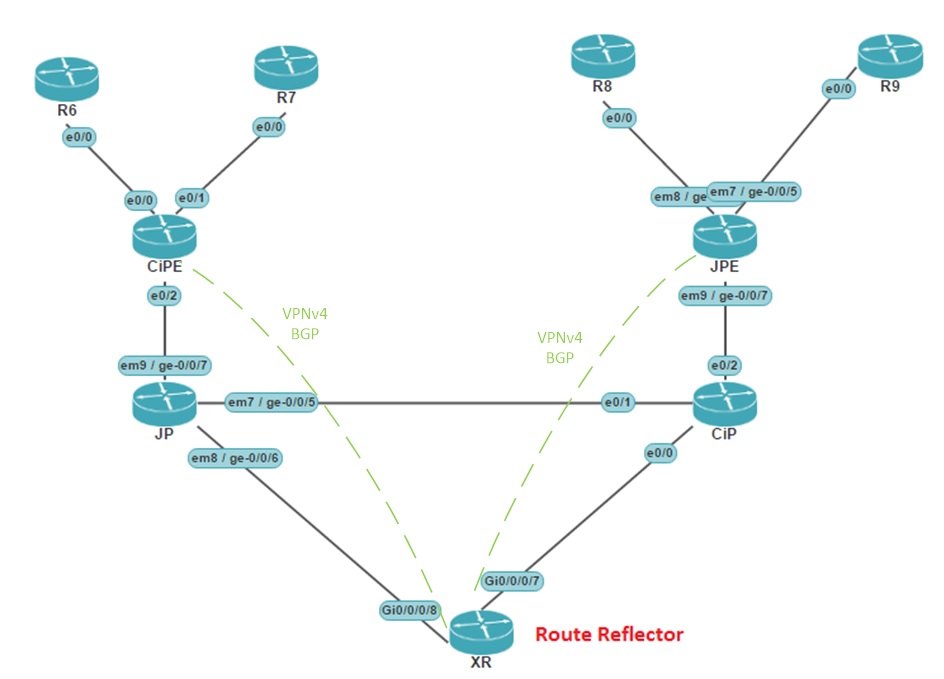


Configuring BGP as PE-CE protocol:


R6:


router bgp 65000
 bgp log-neighbor-changes
 network 12.12.12.12 mask 255.255.255.255
 network 66.66.66.66 mask 255.255.255.255
 neighbor 192.168.1.1 remote-as 65002

R8:


router bgp 65000
 bgp log-neighbor-changes
 network 44.44.44.44 mask 255.255.255.255
 network 88.88.88.88 mask 255.255.255.255
 neighbor 192.168.2.1 remote-as 65001

CiPE:


IOS PE Configuration is really easy, just configure the peer, I have used a different AS-Number and this is the reason for local-as, by default is not necessary. If we don't use the same AS in both CE AS-Override.

 address-family ipv4 vrf EVEN
  neighbor 192.168.1.2 remote-as 65000
  neighbor 192.168.1.2 local-as 65002
  neighbor 192.168.1.2 activate
  neighbor 192.168.1.2 as-override

JPE:

JunOS configuration is very similar than the cisco for the BGP.

set routing-instances EVEN protocols bgp group R8 peer-as 65000
set routing-instances EVEN protocols bgp group R8 local-as 65001
set routing-instances EVEN protocols bgp group R8 as-override
set routing-instances EVEN protocols bgp group R8 neighbor 192.168.2.2

Reference Link about AS-Override:


Verification:


R6:


The routing table have all the needed routes, ping to the other CE is working, and tracert is also working.

R6#show ip route
Codes: L - local, C - connected, S - static, R - RIP, M - mobile, B - BGP
       D - EIGRP, EX - EIGRP external, O - OSPF, IA - OSPF inter area
       N1 - OSPF NSSA external type 1, N2 - OSPF NSSA external type 2
       E1 - OSPF external type 1, E2 - OSPF external type 2
       i - IS-IS, su - IS-IS summary, L1 - IS-IS level-1, L2 - IS-IS level-2
       ia - IS-IS inter area, * - candidate default, U - per-user static route
       o - ODR, P - periodic downloaded static route, H - NHRP, l - LISP
       a - application route
       + - replicated route, % - next hop override

Gateway of last resort is not set

      12.0.0.0/32 is subnetted, 1 subnets
C        12.12.12.12 is directly connected, Loopback12
      44.0.0.0/32 is subnetted, 1 subnets
B        44.44.44.44 [20/0] via 192.168.1.1, 00:04:51
      66.0.0.0/32 is subnetted, 1 subnets
C        66.66.66.66 is directly connected, Loopback66
      88.0.0.0/32 is subnetted, 1 subnets
B        88.88.88.88 [20/0] via 192.168.1.1, 00:04:51
      192.168.1.0/24 is variably subnetted, 2 subnets, 2 masks
C        192.168.1.0/24 is directly connected, Ethernet0/0
L        192.168.1.2/32 is directly connected, Ethernet0/0
B     192.168.2.0/24 [20/0] via 192.168.1.1, 00:04:51

R6#ping 44.44.44.44 source loop 66
Type escape sequence to abort.
Sending 5, 100-byte ICMP Echos to 44.44.44.44, timeout is 2 seconds:
Packet sent with a source address of 66.66.66.66
!!!!!
Success rate is 100 percent (5/5), round-trip min/avg/max = 3/3/5 ms

R6#trace 44.44.44.44
Type escape sequence to abort.
Tracing the route to 44.44.44.44
VRF info: (vrf in name/id, vrf out name/id)
  1 192.168.1.1 [AS 100] 0 msec 1 msec 4 msec
  2  *  *  *
  3 10.0.2.2 [MPLS: Labels 16/16 Exp 0] 3 msec 3 msec 4 msec
  4 192.168.2.1 [AS 100] 3 msec 4 msec 3 msec
  5 192.168.2.2 [AS 100] 4 msec 4 msec *
R6#

R8:


R8 have also the right information in the routing table, connectivity was tested previously from R6.

R8#show ip route
Codes: L - local, C - connected, S - static, R - RIP, M - mobile, B - BGP
       D - EIGRP, EX - EIGRP external, O - OSPF, IA - OSPF inter area
       N1 - OSPF NSSA external type 1, N2 - OSPF NSSA external type 2
       E1 - OSPF external type 1, E2 - OSPF external type 2
       i - IS-IS, su - IS-IS summary, L1 - IS-IS level-1, L2 - IS-IS level-2
       ia - IS-IS inter area, * - candidate default, U - per-user static route
       o - ODR, P - periodic downloaded static route, H - NHRP, l - LISP
       a - application route
       + - replicated route, % - next hop override

Gateway of last resort is not set

      12.0.0.0/32 is subnetted, 1 subnets
B        12.12.12.12 [20/0] via 192.168.2.1, 00:00:37
      44.0.0.0/32 is subnetted, 1 subnets
C        44.44.44.44 is directly connected, Loopback44
      66.0.0.0/32 is subnetted, 1 subnets
B        66.66.66.66 [20/0] via 192.168.2.1, 00:00:37
      88.0.0.0/32 is subnetted, 1 subnets
C        88.88.88.88 is directly connected, Loopback88
B     192.168.1.0/24 [20/0] via 192.168.2.1, 00:12:48
      192.168.2.0/24 is variably subnetted, 2 subnets, 2 masks
C        192.168.2.0/24 is directly connected, Ethernet0/0
L        192.168.2.2/32 is directly connected, Ethernet0/0

CiPE:


All routes seen via BGP, but remotes with the next hop of the LDP router-ID,

CiPE#show ip route vrf EVEN

Routing Table: EVEN
Codes: L - local, C - connected, S - static, R - RIP, M - mobile, B - BGP
       D - EIGRP, EX - EIGRP external, O - OSPF, IA - OSPF inter area
       N1 - OSPF NSSA external type 1, N2 - OSPF NSSA external type 2
       E1 - OSPF external type 1, E2 - OSPF external type 2
       i - IS-IS, su - IS-IS summary, L1 - IS-IS level-1, L2 - IS-IS level-2
       ia - IS-IS inter area, * - candidate default, U - per-user static route
       o - ODR, P - periodic downloaded static route, H - NHRP, l - LISP
       a - application route
       + - replicated route, % - next hop override

Gateway of last resort is not set

      12.0.0.0/32 is subnetted, 1 subnets
B        12.12.12.12 [20/0] via 192.168.1.2, 00:15:35
      44.0.0.0/32 is subnetted, 1 subnets
B        44.44.44.44 [200/0] via 5.5.5.5, 00:27:46
      66.0.0.0/32 is subnetted, 1 subnets
B        66.66.66.66 [20/0] via 192.168.1.2, 00:15:35
      88.0.0.0/32 is subnetted, 1 subnets
B        88.88.88.88 [200/0] via 5.5.5.5, 00:27:46
      192.168.1.0/24 is variably subnetted, 2 subnets, 2 masks
C        192.168.1.0/24 is directly connected, Ethernet0/0
L        192.168.1.1/32 is directly connected, Ethernet0/0
B     192.168.2.0/24 [200/0] via 5.5.5.5, 00:27:46

JPE:


Same information in the routing table of JunOS.

lab@JPE> show route table EVEN.inet.0

EVEN.inet.0: 8 destinations, 8 routes (8 active, 0 holddown, 0 hidden)
+ = Active Route, - = Last Active, * = Both

12.12.12.12/32     *[BGP/170] 00:16:49, MED 0, localpref 100, from 1.1.1.1
                      AS path: 65002 65000 I, validation-state: unverified
                    > to 10.0.4.1 via ge-0/0/7.0, Push 24, Push 21(top)
44.44.44.44/32     *[BGP/170] 00:43:29, MED 0, localpref 100
                      AS path: 65000 I, validation-state: unverified
                    > to 192.168.2.2 via ge-0/0/6.0
66.66.66.66/32     *[BGP/170] 00:16:49, MED 0, localpref 100, from 1.1.1.1
                      AS path: 65002 65000 I, validation-state: unverified
                    > to 10.0.4.1 via ge-0/0/7.0, Push 25, Push 21(top)
88.88.88.88/32     *[BGP/170] 00:43:29, MED 0, localpref 100
                      AS path: 65000 I, validation-state: unverified
                    > to 192.168.2.2 via ge-0/0/6.0
192.168.1.0/24     *[BGP/170] 00:29:00, MED 0, localpref 100, from 1.1.1.1
                      AS path: I, validation-state: unverified
                    > to 10.0.4.1 via ge-0/0/7.0, Push 35, Push 21(top)
192.168.2.0/24     *[Direct/0] 01:38:23
                    > via ge-0/0/6.0
192.168.2.1/32     *[Local/0] 01:38:24
                      Local via ge-0/0/6.0

MPLS Multi Vendor(5/6): Configuring OSPF as PE-CE protocol


In previous articles we configured the MPLS core with IS-IS and LDP, we configured also MP-BGP between the PEs and the VPNv4 Route Reflector, and we have tested that we have reachability PE to PE for each VRF/Routing Instance.

In this article, we are going to configure the ODD routers with OSPF as the routing protocol between PE and CE.


Configuring OSPF as PE-CE protocol:


R7:


hostname R7
interface Loopback14
 ip address 14.14.14.14 255.255.255.255
interface Loopback77
 ip address 77.77.77.77 255.255.255.255
interface Ethernet0/0
 ip address 172.16.1.2 255.255.255.0

router ospf 1
 network 14.14.14.14 0.0.0.0 area 0
 network 77.77.77.77 0.0.0.0 area 0
 network 172.16.1.2 0.0.0.0 area 0

R9:


hostname R9
interface Loopback18
 ip address 18.18.18.18 255.255.255.255
interface Loopback99
 ip address 99.99.99.99 255.255.255.255
interface Ethernet0/0
 ip address 172.16.2.2 255.255.255.0

router ospf 1
 network 18.18.18.18 0.0.0.0 area 0
 network 99.99.99.99 0.0.0.0 area 0
 network 172.16.2.2 0.0.0.0 area 0

CiPE:


Cisco IOS PE configuration is very similar using OSPF than using RIP, create OSPF process, assign the interface and redistribute in both directions. An important point to remember is, doesn't forget subnets in the redistribution to OSPF, like in any other redistribution to OSPF.

router ospf 1 vrf ODD
 redistribute bgp 100 subnets
 network 172.16.1.1 0.0.0.0 area 0

router bgp 100
 address-family ipv4 vrf ODD
  network 172.16.1.0 mask 255.255.255.0
  redistribute ospf 1
 exit-address-family


JPE:
Junos OSPF PE-CE configuration is also very similar than RIP. But if your customer doesn't want to receive the routes as external routes you need to create sham links.

set policy-options policy-statement to_OSPF from protocol bgp
set policy-options policy-statement to_OSPF then accept
set routing-instances ODD protocols ospf export to_OSPF
set routing-instances ODD protocols ospf area 0.0.0.0 interface ge-0/0/5.0

Reference link:


Verification:


R7:


The routing table have all the needed routes, ping to the other CE is working, and tracert is also working.

R7#show ip route
Codes: L - local, C - connected, S - static, R - RIP, M - mobile, B - BGP
       D - EIGRP, EX - EIGRP external, O - OSPF, IA - OSPF inter area
       N1 - OSPF NSSA external type 1, N2 - OSPF NSSA external type 2
       E1 - OSPF external type 1, E2 - OSPF external type 2
       i - IS-IS, su - IS-IS summary, L1 - IS-IS level-1, L2 - IS-IS level-2
       ia - IS-IS inter area, * - candidate default, U - per-user static route
       o - ODR, P - periodic downloaded static route, H - NHRP, l - LISP
       a - application route
       + - replicated route, % - next hop override

Gateway of last resort is not set

      14.0.0.0/32 is subnetted, 1 subnets
C        14.14.14.14 is directly connected, Loopback14
      18.0.0.0/32 is subnetted, 1 subnets
O E2     18.18.18.18 [110/2] via 172.16.1.1, 00:33:59, Ethernet0/0
      77.0.0.0/32 is subnetted, 1 subnets
C        77.77.77.77 is directly connected, Loopback77
      99.0.0.0/32 is subnetted, 1 subnets
O E2     99.99.99.99 [110/2] via 172.16.1.1, 00:33:59, Ethernet0/0
      172.16.0.0/16 is variably subnetted, 3 subnets, 2 masks
C        172.16.1.0/24 is directly connected, Ethernet0/0
L        172.16.1.2/32 is directly connected, Ethernet0/0
O E2     172.16.2.0/24 [110/1] via 172.16.1.1, 00:33:59, Ethernet0/0
R7#ping 99.99.99.99 source loop 77
Type escape sequence to abort.
Sending 5, 100-byte ICMP Echos to 99.99.99.99, timeout is 2 seconds:
Packet sent with a source address of 77.77.77.77
!!!!!
Success rate is 100 percent (5/5), round-trip min/avg/max = 3/3/4 ms
R7#trace 99.99.99.99
Type escape sequence to abort.
Tracing the route to 99.99.99.99
VRF info: (vrf in name/id, vrf out name/id)
  1 172.16.1.1 0 msec 1 msec 4 msec
  2  *  *  *
  3 10.0.2.2 [MPLS: Labels 16/17 Exp 0] 4 msec 4 msec 3 msec
  4 172.16.2.1 10 msec 4 msec 3 msec
  5 172.16.2.2 9 msec 4 msec *

R9:


R9 have also the right information in the routing table, connectivity was tested previously from R7.

R9#show ip route
Codes: L - local, C - connected, S - static, R - RIP, M - mobile, B - BGP
       D - EIGRP, EX - EIGRP external, O - OSPF, IA - OSPF inter area
       N1 - OSPF NSSA external type 1, N2 - OSPF NSSA external type 2
       E1 - OSPF external type 1, E2 - OSPF external type 2
       i - IS-IS, su - IS-IS summary, L1 - IS-IS level-1, L2 - IS-IS level-2
       ia - IS-IS inter area, * - candidate default, U - per-user static route
       o - ODR, P - periodic downloaded static route, H - NHRP, l - LISP
       a - application route
       + - replicated route, % - next hop override

Gateway of last resort is not set

      14.0.0.0/32 is subnetted, 1 subnets
O E1     14.14.14.14 [110/21] via 172.16.2.1, 00:35:00, Ethernet0/0
      18.0.0.0/32 is subnetted, 1 subnets
C        18.18.18.18 is directly connected, Loopback18
      77.0.0.0/32 is subnetted, 1 subnets
O E1     77.77.77.77 [110/21] via 172.16.2.1, 00:35:00, Ethernet0/0
      99.0.0.0/32 is subnetted, 1 subnets
C        99.99.99.99 is directly connected, Loopback99
      172.16.0.0/16 is variably subnetted, 3 subnets, 2 masks
O E1     172.16.1.0/24 [110/10] via 172.16.2.1, 00:35:00, Ethernet0/0
C        172.16.2.0/24 is directly connected, Ethernet0/0
L        172.16.2.2/32 is directly connected, Ethernet0/0

CiPE:


CiPE shows the local routes via OSPF, and remote routes via BGP as expected.

CiPE#show ip route vrf ODD

Routing Table: ODD
Codes: L - local, C - connected, S - static, R - RIP, M - mobile, B - BGP
       D - EIGRP, EX - EIGRP external, O - OSPF, IA - OSPF inter area
       N1 - OSPF NSSA external type 1, N2 - OSPF NSSA external type 2
       E1 - OSPF external type 1, E2 - OSPF external type 2
       i - IS-IS, su - IS-IS summary, L1 - IS-IS level-1, L2 - IS-IS level-2
       ia - IS-IS inter area, * - candidate default, U - per-user static route
       o - ODR, P - periodic downloaded static route, H - NHRP, l - LISP
       a - application route
       + - replicated route, % - next hop override

Gateway of last resort is not set

      14.0.0.0/32 is subnetted, 1 subnets
O        14.14.14.14 [110/11] via 172.16.1.2, 00:42:03, Ethernet0/1
      18.0.0.0/32 is subnetted, 1 subnets
B        18.18.18.18 [200/2] via 5.5.5.5, 00:37:50
      77.0.0.0/32 is subnetted, 1 subnets
O        77.77.77.77 [110/11] via 172.16.1.2, 00:42:03, Ethernet0/1
      99.0.0.0/32 is subnetted, 1 subnets
B        99.99.99.99 [200/2] via 5.5.5.5, 00:37:50
      172.16.0.0/16 is variably subnetted, 3 subnets, 2 masks
C        172.16.1.0/24 is directly connected, Ethernet0/1
L        172.16.1.1/32 is directly connected, Ethernet0/1
B        172.16.2.0/24 [200/0] via 5.5.5.5, 00:37:50

JPE:


Same behaviour for JPE, the final multicast route is the multicast group that uses OSPF DR to communicate with the remaining devices(NonBDR).

lab@JPE> show route table ODD.inet.0

ODD.inet.0: 8 destinations, 8 routes (8 active, 0 holddown, 0 hidden)
+ = Active Route, - = Last Active, * = Both

14.14.14.14/32     *[BGP/170] 00:39:11, MED 11, localpref 100, from 1.1.1.1
                      AS path: ?, validation-state: unverified
                    > to 10.0.4.1 via ge-0/0/7.0, Push 24, Push 21(top)
18.18.18.18/32     *[OSPF/10] 00:40:28, metric 2
                    > to 172.16.2.2 via ge-0/0/5.0
77.77.77.77/32     *[BGP/170] 00:39:11, MED 11, localpref 100, from 1.1.1.1
                      AS path: ?, validation-state: unverified
                    > to 10.0.4.1 via ge-0/0/7.0, Push 25, Push 21(top)
99.99.99.99/32     *[OSPF/10] 00:40:28, metric 2
                    > to 172.16.2.2 via ge-0/0/5.0
172.16.1.0/24      *[BGP/170] 00:39:11, MED 0, localpref 100, from 1.1.1.1
                      AS path: I, validation-state: unverified
                    > to 10.0.4.1 via ge-0/0/7.0, Push 26, Push 21(top)
172.16.2.0/24      *[Direct/0] 00:41:13
                    > via ge-0/0/5.0
172.16.2.1/32      *[Local/0] 00:41:14
                      Local via ge-0/0/5.0
224.0.0.5/32       *[OSPF/10] 00:42:04, metric 1
                      MultiRecv

MPLS Multi Vendor(4/6): Configuring RIP as PE-CE protocol


In previous articles we configured the MPLS core with IS-IS and LDP, we configured also MP-BGP between the PEs and the VPNv4 Route Reflector, and we have tested that we have reachability PE to PE for each VRF/Routing Instance.

In this article we are going to configure the EVEN routers with RIP as the routing protocol between PE and CE.


Configuring RIP as PE-CE protocol:


R6:


hostname R6
interface Loopback12
 ip address 12.12.12.12 255.255.255.255

interface Loopback66
 ip address 66.66.66.66 255.255.255.255

interface Ethernet0/0
 ip address 192.168.1.2 255.255.255.0

router rip
 version 2
 network 12.0.0.0
 network 66.0.0.0
 network 192.168.1.0


R8:


hostname R8
interface Loopback44
 ip address 44.44.44.44 255.255.255.255

interface Loopback88
 ip address 88.88.88.88 255.255.255.255

interface Ethernet0/0
 ip address 192.168.2.2 255.255.255.0

router rip
 version 2
 network 44.0.0.0
 network 88.0.0.0
 network 192.168.2.0


CiPE:


For the IOS router it is needed to create an address family for the vrf inside the rip process and redistribute the BGP(via VPNv4). It is also needed to redistribute in the BGP vrf EVEN address family RIP.

router rip
 address-family ipv4 vrf EVEN
  redistribute bgp 100 metric 3
  network 192.168.1.0
  no auto-summary
  version 2
 exit-address-family

router bgp 100
 address-family ipv4 vrf EVEN
  redistribute rip

An important detail in the BGP to RIP redistributions is that the metric is mandatory, if you don't adjust any metric for the redistribution the routes won't be redistributed.

JPE:


set policy-options policy-statement to_RIP from protocol bgp
set policy-options policy-statement to_RIP then accept
set routing-instances EVEN protocols rip group R8 export to_RIP
set routing-instances EVEN protocols rip group R8 neighbor ge-0/0/6.0


Junos PE-CE Configuration is quite easy, by default Junos inject the routes from the PE-CE protocol to the VPNv4 BGP, but it is needed to create a policy to export the routes from BGP to RIP.


Verification:


R6:


The routing table have all the needed routes, ping to the other CE is working, and tracert is also working.

R6#show ip route
Codes: L - local, C - connected, S - static, R - RIP, M - mobile, B - BGP
       D - EIGRP, EX - EIGRP external, O - OSPF, IA - OSPF inter area
       N1 - OSPF NSSA external type 1, N2 - OSPF NSSA external type 2
       E1 - OSPF external type 1, E2 - OSPF external type 2
       i - IS-IS, su - IS-IS summary, L1 - IS-IS level-1, L2 - IS-IS level-2
       ia - IS-IS inter area, * - candidate default, U - per-user static route
       o - ODR, P - periodic downloaded static route, H - NHRP, l - LISP
       a - application route
       + - replicated route, % - next hop override

Gateway of last resort is not set

      12.0.0.0/32 is subnetted, 1 subnets
C        12.12.12.12 is directly connected, Loopback12
R     44.0.0.0/8 [120/3] via 192.168.1.1, 00:00:14, Ethernet0/0
      66.0.0.0/32 is subnetted, 1 subnets
C        66.66.66.66 is directly connected, Loopback66
R     88.0.0.0/8 [120/3] via 192.168.1.1, 00:00:14, Ethernet0/0
      192.168.1.0/24 is variably subnetted, 2 subnets, 2 masks
C        192.168.1.0/24 is directly connected, Ethernet0/0
L        192.168.1.2/32 is directly connected, Ethernet0/0
R     192.168.2.0/24 [120/3] via 192.168.1.1, 00:00:14, Ethernet0/0

R6#ping 88.88.88.88 source loopback 12
Type escape sequence to abort.
Sending 5, 100-byte ICMP Echos to 88.88.88.88, timeout is 2 seconds:
Packet sent with a source address of 12.12.12.12
!!!!!
Success rate is 100 percent (5/5), round-trip min/avg/max = 3/3/5 ms

R6#traceroute 88.88.88.88
Type escape sequence to abort.
Tracing the route to 88.88.88.88
VRF info: (vrf in name/id, vrf out name/id)
  1 192.168.1.1 1 msec 0 msec 0 msec
  2  *  *  *
  3 10.0.2.2 [MPLS: Labels 18/16 Exp 0] 3 msec 3 msec 3 msec
  4 192.168.2.1 3 msec 3 msec 3 msec
  5 192.168.2.2 3 msec 5 msec *


R8:


R8 have also the right information in the routing table, connectivity was tested previously from R6.

R8#show ip route
Codes: L - local, C - connected, S - static, R - RIP, M - mobile, B - BGP
       D - EIGRP, EX - EIGRP external, O - OSPF, IA - OSPF inter area
       N1 - OSPF NSSA external type 1, N2 - OSPF NSSA external type 2
       E1 - OSPF external type 1, E2 - OSPF external type 2
       i - IS-IS, su - IS-IS summary, L1 - IS-IS level-1, L2 - IS-IS level-2
       ia - IS-IS inter area, * - candidate default, U - per-user static route
       o - ODR, P - periodic downloaded static route, H - NHRP, l - LISP
       a - application route
       + - replicated route, % - next hop override

Gateway of last resort is not set

R     12.0.0.0/8 [120/1] via 192.168.2.1, 00:00:25, Ethernet0/0
      44.0.0.0/32 is subnetted, 1 subnets
C        44.44.44.44 is directly connected, Loopback44
R     66.0.0.0/8 [120/1] via 192.168.2.1, 00:00:25, Ethernet0/0
      88.0.0.0/32 is subnetted, 1 subnets
C        88.88.88.88 is directly connected, Loopback88
R     192.168.1.0/24 [120/1] via 192.168.2.1, 00:00:25, Ethernet0/0
      192.168.2.0/24 is variably subnetted, 2 subnets, 2 masks
C        192.168.2.0/24 is directly connected, Ethernet0/0
L        192.168.2.2/32 is directly connected, Ethernet0/0

CiPE:


CiPE shows the local routes via RIP, and remote routes via BGP as expected.

CiPE#show ip route vrf EVEN

Routing Table: EVEN
Codes: L - local, C - connected, S - static, R - RIP, M - mobile, B - BGP
       D - EIGRP, EX - EIGRP external, O - OSPF, IA - OSPF inter area
       N1 - OSPF NSSA external type 1, N2 - OSPF NSSA external type 2
       E1 - OSPF external type 1, E2 - OSPF external type 2
       i - IS-IS, su - IS-IS summary, L1 - IS-IS level-1, L2 - IS-IS level-2
       ia - IS-IS inter area, * - candidate default, U - per-user static route
       o - ODR, P - periodic downloaded static route, H - NHRP, l - LISP
       a - application route
       + - replicated route, % - next hop override

Gateway of last resort is not set

R     12.0.0.0/8 [120/1] via 192.168.1.2, 00:00:18, Ethernet0/0
B     44.0.0.0/8 [200/2] via 5.5.5.5, 00:35:11
R     66.0.0.0/8 [120/1] via 192.168.1.2, 00:00:18, Ethernet0/0
B     88.0.0.0/8 [200/2] via 5.5.5.5, 00:35:11
      192.168.1.0/24 is variably subnetted, 2 subnets, 2 masks
C        192.168.1.0/24 is directly connected, Ethernet0/0
L        192.168.1.1/32 is directly connected, Ethernet0/0
B     192.168.2.0/24 [200/0] via 5.5.5.5, 02:31:29

JPE:


Same behaviour for JPE, the final multicast route is due RIP version 2 uses a multicast group to exchange the information with all the routers in the link.

lab@JPE> show route table EVEN.inet.0

EVEN.inet.0: 8 destinations, 8 routes (8 active, 0 holddown, 0 hidden)
+ = Active Route, - = Last Active, * = Both

12.0.0.0/8         *[BGP/170] 01:16:24, MED 1, localpref 100, from 1.1.1.1
                      AS path: ?, validation-state: unverified
                    > to 10.0.4.1 via ge-0/0/7.0, Push 26, Push 21(top)
44.0.0.0/8         *[RIP/100] 00:37:10, metric 2, tag 0
                    > to 192.168.2.2 via ge-0/0/6.0
66.0.0.0/8         *[BGP/170] 01:16:24, MED 1, localpref 100, from 1.1.1.1
                      AS path: ?, validation-state: unverified
                    > to 10.0.4.1 via ge-0/0/7.0, Push 27, Push 21(top)
88.0.0.0/8         *[RIP/100] 00:37:10, metric 2, tag 0
                    > to 192.168.2.2 via ge-0/0/6.0
192.168.1.0/24     *[BGP/170] 01:16:24, MED 0, localpref 100, from 1.1.1.1
                      AS path: I, validation-state: unverified
                    > to 10.0.4.1 via ge-0/0/7.0, Push 25, Push 21(top)
192.168.2.0/24     *[Direct/0] 02:56:27
                    > via ge-0/0/6.0
192.168.2.1/32     *[Local/0] 02:56:28
                      Local via ge-0/0/6.0
224.0.0.9/32       *[RIP/100] 00:28:16, metric 1
                      MultiRecv