Mostrando entradas con la etiqueta MP-BGP. Mostrar todas las entradas

MPLS Multi Vendor(6/6): Configuring BGP as PE-CE protocol


In previous articles we configured the MPLS core with IS-IS and LDP, we configured also MP-BGP between the PEs and the VPNv4 Route Reflector, and we have tested that we have reachability PE to PE for each VRF/Routing Instance.

In this article, we are going to configure the EVEN routers with BGP as the routing protocol between PE and CE. Maybe is the easiest protocol to configure between PE-CE for a service provider, but some extra configuration(as-override) will be necessary if the customer uses same AS in different branches.
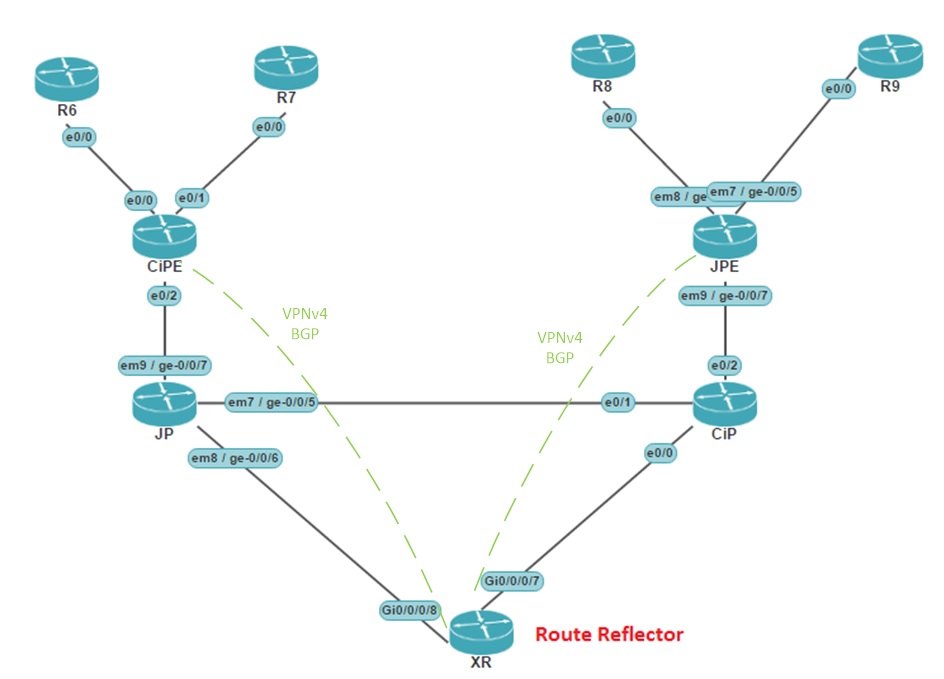


Configuring BGP as PE-CE protocol:


R6:


router bgp 65000
 bgp log-neighbor-changes
 network 12.12.12.12 mask 255.255.255.255
 network 66.66.66.66 mask 255.255.255.255
 neighbor 192.168.1.1 remote-as 65002

R8:


router bgp 65000
 bgp log-neighbor-changes
 network 44.44.44.44 mask 255.255.255.255
 network 88.88.88.88 mask 255.255.255.255
 neighbor 192.168.2.1 remote-as 65001

CiPE:


IOS PE Configuration is really easy, just configure the peer, I have used a different AS-Number and this is the reason for local-as, by default is not necessary. If we don't use the same AS in both CE AS-Override.

 address-family ipv4 vrf EVEN
  neighbor 192.168.1.2 remote-as 65000
  neighbor 192.168.1.2 local-as 65002
  neighbor 192.168.1.2 activate
  neighbor 192.168.1.2 as-override

JPE:

JunOS configuration is very similar than the cisco for the BGP.

set routing-instances EVEN protocols bgp group R8 peer-as 65000
set routing-instances EVEN protocols bgp group R8 local-as 65001
set routing-instances EVEN protocols bgp group R8 as-override
set routing-instances EVEN protocols bgp group R8 neighbor 192.168.2.2

Reference Link about AS-Override:


Verification:


R6:


The routing table have all the needed routes, ping to the other CE is working, and tracert is also working.

R6#show ip route
Codes: L - local, C - connected, S - static, R - RIP, M - mobile, B - BGP
       D - EIGRP, EX - EIGRP external, O - OSPF, IA - OSPF inter area
       N1 - OSPF NSSA external type 1, N2 - OSPF NSSA external type 2
       E1 - OSPF external type 1, E2 - OSPF external type 2
       i - IS-IS, su - IS-IS summary, L1 - IS-IS level-1, L2 - IS-IS level-2
       ia - IS-IS inter area, * - candidate default, U - per-user static route
       o - ODR, P - periodic downloaded static route, H - NHRP, l - LISP
       a - application route
       + - replicated route, % - next hop override

Gateway of last resort is not set

      12.0.0.0/32 is subnetted, 1 subnets
C        12.12.12.12 is directly connected, Loopback12
      44.0.0.0/32 is subnetted, 1 subnets
B        44.44.44.44 [20/0] via 192.168.1.1, 00:04:51
      66.0.0.0/32 is subnetted, 1 subnets
C        66.66.66.66 is directly connected, Loopback66
      88.0.0.0/32 is subnetted, 1 subnets
B        88.88.88.88 [20/0] via 192.168.1.1, 00:04:51
      192.168.1.0/24 is variably subnetted, 2 subnets, 2 masks
C        192.168.1.0/24 is directly connected, Ethernet0/0
L        192.168.1.2/32 is directly connected, Ethernet0/0
B     192.168.2.0/24 [20/0] via 192.168.1.1, 00:04:51

R6#ping 44.44.44.44 source loop 66
Type escape sequence to abort.
Sending 5, 100-byte ICMP Echos to 44.44.44.44, timeout is 2 seconds:
Packet sent with a source address of 66.66.66.66
!!!!!
Success rate is 100 percent (5/5), round-trip min/avg/max = 3/3/5 ms

R6#trace 44.44.44.44
Type escape sequence to abort.
Tracing the route to 44.44.44.44
VRF info: (vrf in name/id, vrf out name/id)
  1 192.168.1.1 [AS 100] 0 msec 1 msec 4 msec
  2  *  *  *
  3 10.0.2.2 [MPLS: Labels 16/16 Exp 0] 3 msec 3 msec 4 msec
  4 192.168.2.1 [AS 100] 3 msec 4 msec 3 msec
  5 192.168.2.2 [AS 100] 4 msec 4 msec *
R6#

R8:


R8 have also the right information in the routing table, connectivity was tested previously from R6.

R8#show ip route
Codes: L - local, C - connected, S - static, R - RIP, M - mobile, B - BGP
       D - EIGRP, EX - EIGRP external, O - OSPF, IA - OSPF inter area
       N1 - OSPF NSSA external type 1, N2 - OSPF NSSA external type 2
       E1 - OSPF external type 1, E2 - OSPF external type 2
       i - IS-IS, su - IS-IS summary, L1 - IS-IS level-1, L2 - IS-IS level-2
       ia - IS-IS inter area, * - candidate default, U - per-user static route
       o - ODR, P - periodic downloaded static route, H - NHRP, l - LISP
       a - application route
       + - replicated route, % - next hop override

Gateway of last resort is not set

      12.0.0.0/32 is subnetted, 1 subnets
B        12.12.12.12 [20/0] via 192.168.2.1, 00:00:37
      44.0.0.0/32 is subnetted, 1 subnets
C        44.44.44.44 is directly connected, Loopback44
      66.0.0.0/32 is subnetted, 1 subnets
B        66.66.66.66 [20/0] via 192.168.2.1, 00:00:37
      88.0.0.0/32 is subnetted, 1 subnets
C        88.88.88.88 is directly connected, Loopback88
B     192.168.1.0/24 [20/0] via 192.168.2.1, 00:12:48
      192.168.2.0/24 is variably subnetted, 2 subnets, 2 masks
C        192.168.2.0/24 is directly connected, Ethernet0/0
L        192.168.2.2/32 is directly connected, Ethernet0/0

CiPE:


All routes seen via BGP, but remotes with the next hop of the LDP router-ID,

CiPE#show ip route vrf EVEN

Routing Table: EVEN
Codes: L - local, C - connected, S - static, R - RIP, M - mobile, B - BGP
       D - EIGRP, EX - EIGRP external, O - OSPF, IA - OSPF inter area
       N1 - OSPF NSSA external type 1, N2 - OSPF NSSA external type 2
       E1 - OSPF external type 1, E2 - OSPF external type 2
       i - IS-IS, su - IS-IS summary, L1 - IS-IS level-1, L2 - IS-IS level-2
       ia - IS-IS inter area, * - candidate default, U - per-user static route
       o - ODR, P - periodic downloaded static route, H - NHRP, l - LISP
       a - application route
       + - replicated route, % - next hop override

Gateway of last resort is not set

      12.0.0.0/32 is subnetted, 1 subnets
B        12.12.12.12 [20/0] via 192.168.1.2, 00:15:35
      44.0.0.0/32 is subnetted, 1 subnets
B        44.44.44.44 [200/0] via 5.5.5.5, 00:27:46
      66.0.0.0/32 is subnetted, 1 subnets
B        66.66.66.66 [20/0] via 192.168.1.2, 00:15:35
      88.0.0.0/32 is subnetted, 1 subnets
B        88.88.88.88 [200/0] via 5.5.5.5, 00:27:46
      192.168.1.0/24 is variably subnetted, 2 subnets, 2 masks
C        192.168.1.0/24 is directly connected, Ethernet0/0
L        192.168.1.1/32 is directly connected, Ethernet0/0
B     192.168.2.0/24 [200/0] via 5.5.5.5, 00:27:46

JPE:


Same information in the routing table of JunOS.

lab@JPE> show route table EVEN.inet.0

EVEN.inet.0: 8 destinations, 8 routes (8 active, 0 holddown, 0 hidden)
+ = Active Route, - = Last Active, * = Both

12.12.12.12/32     *[BGP/170] 00:16:49, MED 0, localpref 100, from 1.1.1.1
                      AS path: 65002 65000 I, validation-state: unverified
                    > to 10.0.4.1 via ge-0/0/7.0, Push 24, Push 21(top)
44.44.44.44/32     *[BGP/170] 00:43:29, MED 0, localpref 100
                      AS path: 65000 I, validation-state: unverified
                    > to 192.168.2.2 via ge-0/0/6.0
66.66.66.66/32     *[BGP/170] 00:16:49, MED 0, localpref 100, from 1.1.1.1
                      AS path: 65002 65000 I, validation-state: unverified
                    > to 10.0.4.1 via ge-0/0/7.0, Push 25, Push 21(top)
88.88.88.88/32     *[BGP/170] 00:43:29, MED 0, localpref 100
                      AS path: 65000 I, validation-state: unverified
                    > to 192.168.2.2 via ge-0/0/6.0
192.168.1.0/24     *[BGP/170] 00:29:00, MED 0, localpref 100, from 1.1.1.1
                      AS path: I, validation-state: unverified
                    > to 10.0.4.1 via ge-0/0/7.0, Push 35, Push 21(top)
192.168.2.0/24     *[Direct/0] 01:38:23
                    > via ge-0/0/6.0
192.168.2.1/32     *[Local/0] 01:38:24
                      Local via ge-0/0/6.0

MPLS Multi Vendor(5/6): Configuring OSPF as PE-CE protocol


In previous articles we configured the MPLS core with IS-IS and LDP, we configured also MP-BGP between the PEs and the VPNv4 Route Reflector, and we have tested that we have reachability PE to PE for each VRF/Routing Instance.

In this article, we are going to configure the ODD routers with OSPF as the routing protocol between PE and CE.


Configuring OSPF as PE-CE protocol:


R7:


hostname R7
interface Loopback14
 ip address 14.14.14.14 255.255.255.255
interface Loopback77
 ip address 77.77.77.77 255.255.255.255
interface Ethernet0/0
 ip address 172.16.1.2 255.255.255.0

router ospf 1
 network 14.14.14.14 0.0.0.0 area 0
 network 77.77.77.77 0.0.0.0 area 0
 network 172.16.1.2 0.0.0.0 area 0

R9:


hostname R9
interface Loopback18
 ip address 18.18.18.18 255.255.255.255
interface Loopback99
 ip address 99.99.99.99 255.255.255.255
interface Ethernet0/0
 ip address 172.16.2.2 255.255.255.0

router ospf 1
 network 18.18.18.18 0.0.0.0 area 0
 network 99.99.99.99 0.0.0.0 area 0
 network 172.16.2.2 0.0.0.0 area 0

CiPE:


Cisco IOS PE configuration is very similar using OSPF than using RIP, create OSPF process, assign the interface and redistribute in both directions. An important point to remember is, doesn't forget subnets in the redistribution to OSPF, like in any other redistribution to OSPF.

router ospf 1 vrf ODD
 redistribute bgp 100 subnets
 network 172.16.1.1 0.0.0.0 area 0

router bgp 100
 address-family ipv4 vrf ODD
  network 172.16.1.0 mask 255.255.255.0
  redistribute ospf 1
 exit-address-family


JPE:
Junos OSPF PE-CE configuration is also very similar than RIP. But if your customer doesn't want to receive the routes as external routes you need to create sham links.

set policy-options policy-statement to_OSPF from protocol bgp
set policy-options policy-statement to_OSPF then accept
set routing-instances ODD protocols ospf export to_OSPF
set routing-instances ODD protocols ospf area 0.0.0.0 interface ge-0/0/5.0

Reference link:


Verification:


R7:


The routing table have all the needed routes, ping to the other CE is working, and tracert is also working.

R7#show ip route
Codes: L - local, C - connected, S - static, R - RIP, M - mobile, B - BGP
       D - EIGRP, EX - EIGRP external, O - OSPF, IA - OSPF inter area
       N1 - OSPF NSSA external type 1, N2 - OSPF NSSA external type 2
       E1 - OSPF external type 1, E2 - OSPF external type 2
       i - IS-IS, su - IS-IS summary, L1 - IS-IS level-1, L2 - IS-IS level-2
       ia - IS-IS inter area, * - candidate default, U - per-user static route
       o - ODR, P - periodic downloaded static route, H - NHRP, l - LISP
       a - application route
       + - replicated route, % - next hop override

Gateway of last resort is not set

      14.0.0.0/32 is subnetted, 1 subnets
C        14.14.14.14 is directly connected, Loopback14
      18.0.0.0/32 is subnetted, 1 subnets
O E2     18.18.18.18 [110/2] via 172.16.1.1, 00:33:59, Ethernet0/0
      77.0.0.0/32 is subnetted, 1 subnets
C        77.77.77.77 is directly connected, Loopback77
      99.0.0.0/32 is subnetted, 1 subnets
O E2     99.99.99.99 [110/2] via 172.16.1.1, 00:33:59, Ethernet0/0
      172.16.0.0/16 is variably subnetted, 3 subnets, 2 masks
C        172.16.1.0/24 is directly connected, Ethernet0/0
L        172.16.1.2/32 is directly connected, Ethernet0/0
O E2     172.16.2.0/24 [110/1] via 172.16.1.1, 00:33:59, Ethernet0/0
R7#ping 99.99.99.99 source loop 77
Type escape sequence to abort.
Sending 5, 100-byte ICMP Echos to 99.99.99.99, timeout is 2 seconds:
Packet sent with a source address of 77.77.77.77
!!!!!
Success rate is 100 percent (5/5), round-trip min/avg/max = 3/3/4 ms
R7#trace 99.99.99.99
Type escape sequence to abort.
Tracing the route to 99.99.99.99
VRF info: (vrf in name/id, vrf out name/id)
  1 172.16.1.1 0 msec 1 msec 4 msec
  2  *  *  *
  3 10.0.2.2 [MPLS: Labels 16/17 Exp 0] 4 msec 4 msec 3 msec
  4 172.16.2.1 10 msec 4 msec 3 msec
  5 172.16.2.2 9 msec 4 msec *

R9:


R9 have also the right information in the routing table, connectivity was tested previously from R7.

R9#show ip route
Codes: L - local, C - connected, S - static, R - RIP, M - mobile, B - BGP
       D - EIGRP, EX - EIGRP external, O - OSPF, IA - OSPF inter area
       N1 - OSPF NSSA external type 1, N2 - OSPF NSSA external type 2
       E1 - OSPF external type 1, E2 - OSPF external type 2
       i - IS-IS, su - IS-IS summary, L1 - IS-IS level-1, L2 - IS-IS level-2
       ia - IS-IS inter area, * - candidate default, U - per-user static route
       o - ODR, P - periodic downloaded static route, H - NHRP, l - LISP
       a - application route
       + - replicated route, % - next hop override

Gateway of last resort is not set

      14.0.0.0/32 is subnetted, 1 subnets
O E1     14.14.14.14 [110/21] via 172.16.2.1, 00:35:00, Ethernet0/0
      18.0.0.0/32 is subnetted, 1 subnets
C        18.18.18.18 is directly connected, Loopback18
      77.0.0.0/32 is subnetted, 1 subnets
O E1     77.77.77.77 [110/21] via 172.16.2.1, 00:35:00, Ethernet0/0
      99.0.0.0/32 is subnetted, 1 subnets
C        99.99.99.99 is directly connected, Loopback99
      172.16.0.0/16 is variably subnetted, 3 subnets, 2 masks
O E1     172.16.1.0/24 [110/10] via 172.16.2.1, 00:35:00, Ethernet0/0
C        172.16.2.0/24 is directly connected, Ethernet0/0
L        172.16.2.2/32 is directly connected, Ethernet0/0

CiPE:


CiPE shows the local routes via OSPF, and remote routes via BGP as expected.

CiPE#show ip route vrf ODD

Routing Table: ODD
Codes: L - local, C - connected, S - static, R - RIP, M - mobile, B - BGP
       D - EIGRP, EX - EIGRP external, O - OSPF, IA - OSPF inter area
       N1 - OSPF NSSA external type 1, N2 - OSPF NSSA external type 2
       E1 - OSPF external type 1, E2 - OSPF external type 2
       i - IS-IS, su - IS-IS summary, L1 - IS-IS level-1, L2 - IS-IS level-2
       ia - IS-IS inter area, * - candidate default, U - per-user static route
       o - ODR, P - periodic downloaded static route, H - NHRP, l - LISP
       a - application route
       + - replicated route, % - next hop override

Gateway of last resort is not set

      14.0.0.0/32 is subnetted, 1 subnets
O        14.14.14.14 [110/11] via 172.16.1.2, 00:42:03, Ethernet0/1
      18.0.0.0/32 is subnetted, 1 subnets
B        18.18.18.18 [200/2] via 5.5.5.5, 00:37:50
      77.0.0.0/32 is subnetted, 1 subnets
O        77.77.77.77 [110/11] via 172.16.1.2, 00:42:03, Ethernet0/1
      99.0.0.0/32 is subnetted, 1 subnets
B        99.99.99.99 [200/2] via 5.5.5.5, 00:37:50
      172.16.0.0/16 is variably subnetted, 3 subnets, 2 masks
C        172.16.1.0/24 is directly connected, Ethernet0/1
L        172.16.1.1/32 is directly connected, Ethernet0/1
B        172.16.2.0/24 [200/0] via 5.5.5.5, 00:37:50

JPE:


Same behaviour for JPE, the final multicast route is the multicast group that uses OSPF DR to communicate with the remaining devices(NonBDR).

lab@JPE> show route table ODD.inet.0

ODD.inet.0: 8 destinations, 8 routes (8 active, 0 holddown, 0 hidden)
+ = Active Route, - = Last Active, * = Both

14.14.14.14/32     *[BGP/170] 00:39:11, MED 11, localpref 100, from 1.1.1.1
                      AS path: ?, validation-state: unverified
                    > to 10.0.4.1 via ge-0/0/7.0, Push 24, Push 21(top)
18.18.18.18/32     *[OSPF/10] 00:40:28, metric 2
                    > to 172.16.2.2 via ge-0/0/5.0
77.77.77.77/32     *[BGP/170] 00:39:11, MED 11, localpref 100, from 1.1.1.1
                      AS path: ?, validation-state: unverified
                    > to 10.0.4.1 via ge-0/0/7.0, Push 25, Push 21(top)
99.99.99.99/32     *[OSPF/10] 00:40:28, metric 2
                    > to 172.16.2.2 via ge-0/0/5.0
172.16.1.0/24      *[BGP/170] 00:39:11, MED 0, localpref 100, from 1.1.1.1
                      AS path: I, validation-state: unverified
                    > to 10.0.4.1 via ge-0/0/7.0, Push 26, Push 21(top)
172.16.2.0/24      *[Direct/0] 00:41:13
                    > via ge-0/0/5.0
172.16.2.1/32      *[Local/0] 00:41:14
                      Local via ge-0/0/5.0
224.0.0.5/32       *[OSPF/10] 00:42:04, metric 1
                      MultiRecv

MPLS Multi Vendor(4/6): Configuring RIP as PE-CE protocol


In previous articles we configured the MPLS core with IS-IS and LDP, we configured also MP-BGP between the PEs and the VPNv4 Route Reflector, and we have tested that we have reachability PE to PE for each VRF/Routing Instance.

In this article we are going to configure the EVEN routers with RIP as the routing protocol between PE and CE.


Configuring RIP as PE-CE protocol:


R6:


hostname R6
interface Loopback12
 ip address 12.12.12.12 255.255.255.255

interface Loopback66
 ip address 66.66.66.66 255.255.255.255

interface Ethernet0/0
 ip address 192.168.1.2 255.255.255.0

router rip
 version 2
 network 12.0.0.0
 network 66.0.0.0
 network 192.168.1.0


R8:


hostname R8
interface Loopback44
 ip address 44.44.44.44 255.255.255.255

interface Loopback88
 ip address 88.88.88.88 255.255.255.255

interface Ethernet0/0
 ip address 192.168.2.2 255.255.255.0

router rip
 version 2
 network 44.0.0.0
 network 88.0.0.0
 network 192.168.2.0


CiPE:


For the IOS router it is needed to create an address family for the vrf inside the rip process and redistribute the BGP(via VPNv4). It is also needed to redistribute in the BGP vrf EVEN address family RIP.

router rip
 address-family ipv4 vrf EVEN
  redistribute bgp 100 metric 3
  network 192.168.1.0
  no auto-summary
  version 2
 exit-address-family

router bgp 100
 address-family ipv4 vrf EVEN
  redistribute rip

An important detail in the BGP to RIP redistributions is that the metric is mandatory, if you don't adjust any metric for the redistribution the routes won't be redistributed.

JPE:


set policy-options policy-statement to_RIP from protocol bgp
set policy-options policy-statement to_RIP then accept
set routing-instances EVEN protocols rip group R8 export to_RIP
set routing-instances EVEN protocols rip group R8 neighbor ge-0/0/6.0


Junos PE-CE Configuration is quite easy, by default Junos inject the routes from the PE-CE protocol to the VPNv4 BGP, but it is needed to create a policy to export the routes from BGP to RIP.


Verification:


R6:


The routing table have all the needed routes, ping to the other CE is working, and tracert is also working.

R6#show ip route
Codes: L - local, C - connected, S - static, R - RIP, M - mobile, B - BGP
       D - EIGRP, EX - EIGRP external, O - OSPF, IA - OSPF inter area
       N1 - OSPF NSSA external type 1, N2 - OSPF NSSA external type 2
       E1 - OSPF external type 1, E2 - OSPF external type 2
       i - IS-IS, su - IS-IS summary, L1 - IS-IS level-1, L2 - IS-IS level-2
       ia - IS-IS inter area, * - candidate default, U - per-user static route
       o - ODR, P - periodic downloaded static route, H - NHRP, l - LISP
       a - application route
       + - replicated route, % - next hop override

Gateway of last resort is not set

      12.0.0.0/32 is subnetted, 1 subnets
C        12.12.12.12 is directly connected, Loopback12
R     44.0.0.0/8 [120/3] via 192.168.1.1, 00:00:14, Ethernet0/0
      66.0.0.0/32 is subnetted, 1 subnets
C        66.66.66.66 is directly connected, Loopback66
R     88.0.0.0/8 [120/3] via 192.168.1.1, 00:00:14, Ethernet0/0
      192.168.1.0/24 is variably subnetted, 2 subnets, 2 masks
C        192.168.1.0/24 is directly connected, Ethernet0/0
L        192.168.1.2/32 is directly connected, Ethernet0/0
R     192.168.2.0/24 [120/3] via 192.168.1.1, 00:00:14, Ethernet0/0

R6#ping 88.88.88.88 source loopback 12
Type escape sequence to abort.
Sending 5, 100-byte ICMP Echos to 88.88.88.88, timeout is 2 seconds:
Packet sent with a source address of 12.12.12.12
!!!!!
Success rate is 100 percent (5/5), round-trip min/avg/max = 3/3/5 ms

R6#traceroute 88.88.88.88
Type escape sequence to abort.
Tracing the route to 88.88.88.88
VRF info: (vrf in name/id, vrf out name/id)
  1 192.168.1.1 1 msec 0 msec 0 msec
  2  *  *  *
  3 10.0.2.2 [MPLS: Labels 18/16 Exp 0] 3 msec 3 msec 3 msec
  4 192.168.2.1 3 msec 3 msec 3 msec
  5 192.168.2.2 3 msec 5 msec *


R8:


R8 have also the right information in the routing table, connectivity was tested previously from R6.

R8#show ip route
Codes: L - local, C - connected, S - static, R - RIP, M - mobile, B - BGP
       D - EIGRP, EX - EIGRP external, O - OSPF, IA - OSPF inter area
       N1 - OSPF NSSA external type 1, N2 - OSPF NSSA external type 2
       E1 - OSPF external type 1, E2 - OSPF external type 2
       i - IS-IS, su - IS-IS summary, L1 - IS-IS level-1, L2 - IS-IS level-2
       ia - IS-IS inter area, * - candidate default, U - per-user static route
       o - ODR, P - periodic downloaded static route, H - NHRP, l - LISP
       a - application route
       + - replicated route, % - next hop override

Gateway of last resort is not set

R     12.0.0.0/8 [120/1] via 192.168.2.1, 00:00:25, Ethernet0/0
      44.0.0.0/32 is subnetted, 1 subnets
C        44.44.44.44 is directly connected, Loopback44
R     66.0.0.0/8 [120/1] via 192.168.2.1, 00:00:25, Ethernet0/0
      88.0.0.0/32 is subnetted, 1 subnets
C        88.88.88.88 is directly connected, Loopback88
R     192.168.1.0/24 [120/1] via 192.168.2.1, 00:00:25, Ethernet0/0
      192.168.2.0/24 is variably subnetted, 2 subnets, 2 masks
C        192.168.2.0/24 is directly connected, Ethernet0/0
L        192.168.2.2/32 is directly connected, Ethernet0/0

CiPE:


CiPE shows the local routes via RIP, and remote routes via BGP as expected.

CiPE#show ip route vrf EVEN

Routing Table: EVEN
Codes: L - local, C - connected, S - static, R - RIP, M - mobile, B - BGP
       D - EIGRP, EX - EIGRP external, O - OSPF, IA - OSPF inter area
       N1 - OSPF NSSA external type 1, N2 - OSPF NSSA external type 2
       E1 - OSPF external type 1, E2 - OSPF external type 2
       i - IS-IS, su - IS-IS summary, L1 - IS-IS level-1, L2 - IS-IS level-2
       ia - IS-IS inter area, * - candidate default, U - per-user static route
       o - ODR, P - periodic downloaded static route, H - NHRP, l - LISP
       a - application route
       + - replicated route, % - next hop override

Gateway of last resort is not set

R     12.0.0.0/8 [120/1] via 192.168.1.2, 00:00:18, Ethernet0/0
B     44.0.0.0/8 [200/2] via 5.5.5.5, 00:35:11
R     66.0.0.0/8 [120/1] via 192.168.1.2, 00:00:18, Ethernet0/0
B     88.0.0.0/8 [200/2] via 5.5.5.5, 00:35:11
      192.168.1.0/24 is variably subnetted, 2 subnets, 2 masks
C        192.168.1.0/24 is directly connected, Ethernet0/0
L        192.168.1.1/32 is directly connected, Ethernet0/0
B     192.168.2.0/24 [200/0] via 5.5.5.5, 02:31:29

JPE:


Same behaviour for JPE, the final multicast route is due RIP version 2 uses a multicast group to exchange the information with all the routers in the link.

lab@JPE> show route table EVEN.inet.0

EVEN.inet.0: 8 destinations, 8 routes (8 active, 0 holddown, 0 hidden)
+ = Active Route, - = Last Active, * = Both

12.0.0.0/8         *[BGP/170] 01:16:24, MED 1, localpref 100, from 1.1.1.1
                      AS path: ?, validation-state: unverified
                    > to 10.0.4.1 via ge-0/0/7.0, Push 26, Push 21(top)
44.0.0.0/8         *[RIP/100] 00:37:10, metric 2, tag 0
                    > to 192.168.2.2 via ge-0/0/6.0
66.0.0.0/8         *[BGP/170] 01:16:24, MED 1, localpref 100, from 1.1.1.1
                      AS path: ?, validation-state: unverified
                    > to 10.0.4.1 via ge-0/0/7.0, Push 27, Push 21(top)
88.0.0.0/8         *[RIP/100] 00:37:10, metric 2, tag 0
                    > to 192.168.2.2 via ge-0/0/6.0
192.168.1.0/24     *[BGP/170] 01:16:24, MED 0, localpref 100, from 1.1.1.1
                      AS path: I, validation-state: unverified
                    > to 10.0.4.1 via ge-0/0/7.0, Push 25, Push 21(top)
192.168.2.0/24     *[Direct/0] 02:56:27
                    > via ge-0/0/6.0
192.168.2.1/32     *[Local/0] 02:56:28
                      Local via ge-0/0/6.0
224.0.0.9/32       *[RIP/100] 00:28:16, metric 1
                      MultiRecv

MPLS Multi Vendor(3/6): Configuring VPNv4 MBGP


In previous articles we configured IS-IS and LDP between all the core devices, and create two VRF/Routing-Instances in the PEs. In this article we are going to start with the BGP configuration.
  
The IOS-XR device is going to be VPNv4 BGP Route Reflector, and we are going to have one BGP session against the Cisco IOS PE and Junos PE.


XR:


router bgp 100
 bgp router-id 1.1.1.1
 address-family vpnv4 unicast

 neighbor 4.4.4.4
  remote-as 100
  update-source Loopback0
  address-family vpnv4 unicast
   route-reflector-client


 neighbor 5.5.5.5
  remote-as 100
  update-source Loopback0
  address-family vpnv4 unicast
   route-reflector-client

CiPE:


router bgp 100
 bgp router-id 4.4.4.4
 bgp log-neighbor-changes
 no bgp default ipv4-unicast
 neighbor 1.1.1.1 remote-as 100
 neighbor 1.1.1.1 update-source Loopback0

 address-family vpnv4
  neighbor 1.1.1.1 activate
  neighbor 1.1.1.1 send-community extended
 exit-address-family


JPE:


set protocols bgp group RR type internal
set protocols bgp group RR local-address 5.5.5.5
set protocols bgp group RR family inet-vpn unicast
set protocols bgp group RR neighbor 1.1.1.1
set routing-options router-id 5.5.5.5
set routing-options autonomous-system 100


After the VPNv4 configuration the BGP session will be up, but no prefixes will be received at any peer.

XR:


RP/0/0/CPU0:XR#sh bgp vpnv4 unicast summary
Wed Jun 22 04:41:20.730 UTC
BGP router identifier 1.1.1.1, local AS number 100
BGP generic scan interval 60 secs
Non-stop routing is enabled
BGP table state: Active
Table ID: 0x0   RD version: 0
BGP main routing table version 1
BGP NSR Initial initsync version 1 (Reached)
BGP NSR/ISSU Sync-Group versions 0/0
BGP scan interval 60 secs

BGP is operating in STANDALONE mode.


Process       RcvTblVer   bRIB/RIB   LabelVer  ImportVer  SendTblVer  StandbyVer
Speaker               1          1          1          1           1           0

Neighbor        Spk    AS MsgRcvd MsgSent   TblVer  InQ OutQ  Up/Down  St/PfxRcd
4.4.4.4           0   100      15      13        1    0    0 00:10:28          0
5.5.5.5           0   100      20      18        1    0    0 00:07:36          0

CiPE:


CiPE#show bgp vpnv4 unicast all summary
BGP router identifier 4.4.4.4, local AS number 100
BGP table version is 1, main routing table version 1

Neighbor        V           AS MsgRcvd MsgSent   TblVer  InQ OutQ Up/Down  State/PfxRcd
1.1.1.1         4          100       8       9        1    0    0 00:05:12        0

JPE:


lab@JPE> show bgp summary
Groups: 1 Peers: 1 Down peers: 0
Table          Tot Paths  Act Paths Suppressed    History Damp State    Pending
bgp.l3vpn.0
                       0          0          0          0          0          0
Peer                     AS      InPkt     OutPkt    OutQ   Flaps Last Up/Dwn State|#Active/Received/Accepted/Damped...
1.1.1.1                 100          3          6       0       0        1:28 Establ
  bgp.l3vpn.0: 0/0/0/0

Advertising the local VRF interfaces:


Now start advertising the local interface of each vrf to the BGP. For junos there are not redistribution or network statement commands, all prefixes need to be announced using a route policy.

CiPE:


router bgp 100
 address-family ipv4 vrf EVEN
  network 192.168.1.0
 exit-address-family

 address-family ipv4 vrf ODD
  network 172.16.1.0 mask 255.255.255.0
 exit-address-family


JPE:


set policy-options policy-statement Export_EVEN term 2 from interface ge-0/0/6.0
set policy-options policy-statement Export_EVEN term 2 then community add rt_222:222
set policy-options policy-statement Export_EVEN term 2 then accept
set policy-options policy-statement Export_ODD term 2 from interface ge-0/0/5.0
set policy-options policy-statement Export_ODD term 2 then community add rt_111:111
set policy-options policy-statement Export_ODD term 2 then accept
set routing-instances ODD vrf-table-label
set routing-instances EVEN vrf-table-label

By default Juniper devices has this behaviour: BGP will not advertise the directly connected network to the remote PE router in L3VPN without vrf-table-label or some other route to advertise.

set routing-instances <Routing_instance> vrf-table-label allow to generate a label for this prefixes.


Now we should be able to ping the remote interfaces in the same routing table, and we should be  learning prefixes using VPNv4 MP-BGP. Your basic MPLS network is already working.

CiPE:
CiPE#show bgp vpnv4 unicast all summary
BGP router identifier 4.4.4.4, local AS number 100
BGP table version is 17, main routing table version 17
4 network entries using 624 bytes of memory
4 path entries using 320 bytes of memory
4/4 BGP path/bestpath attribute entries using 640 bytes of memory
1 BGP rrinfo entries using 24 bytes of memory
2 BGP extended community entries using 48 bytes of memory
0 BGP route-map cache entries using 0 bytes of memory
0 BGP filter-list cache entries using 0 bytes of memory
BGP using 1656 total bytes of memory
BGP activity 5/1 prefixes, 5/1 paths, scan interval 60 secs

Neighbor        V           AS MsgRcvd MsgSent   TblVer  InQ OutQ Up/Down  State/PfxRcd
1.1.1.1         4          100      37      40       17    0    0 00:30:15        2

CiPE#show ip route vrf ODD
Routing Table: ODD
Codes: L - local, C - connected, S - static, R - RIP, M - mobile, B - BGP
       D - EIGRP, EX - EIGRP external, O - OSPF, IA - OSPF inter area
       N1 - OSPF NSSA external type 1, N2 - OSPF NSSA external type 2
       E1 - OSPF external type 1, E2 - OSPF external type 2
       i - IS-IS, su - IS-IS summary, L1 - IS-IS level-1, L2 - IS-IS level-2
       ia - IS-IS inter area, * - candidate default, U - per-user static route
       o - ODR, P - periodic downloaded static route, H - NHRP, l - LISP
       a - application route
       + - replicated route, % - next hop override

Gateway of last resort is not set

      172.16.0.0/16 is variably subnetted, 3 subnets, 2 masks
C        172.16.1.0/24 is directly connected, Ethernet0/1
L        172.16.1.1/32 is directly connected, Ethernet0/1
B        172.16.2.0/24 [200/0] via 5.5.5.5, 00:19:25

CiPE#show ip route vrf EVEN
Routing Table: EVEN
Codes: L - local, C - connected, S - static, R - RIP, M - mobile, B - BGP
       D - EIGRP, EX - EIGRP external, O - OSPF, IA - OSPF inter area
       N1 - OSPF NSSA external type 1, N2 - OSPF NSSA external type 2
       E1 - OSPF external type 1, E2 - OSPF external type 2
       i - IS-IS, su - IS-IS summary, L1 - IS-IS level-1, L2 - IS-IS level-2
       ia - IS-IS inter area, * - candidate default, U - per-user static route
       o - ODR, P - periodic downloaded static route, H - NHRP, l - LISP
       a - application route
       + - replicated route, % - next hop override

Gateway of last resort is not set

      192.168.1.0/24 is variably subnetted, 2 subnets, 2 masks
C        192.168.1.0/24 is directly connected, Ethernet0/0
L        192.168.1.1/32 is directly connected, Ethernet0/0
B     192.168.2.0/24 [200/0] via 5.5.5.5, 00:21:03
CiPE#

CiPE#ping vrf EVEN 192.168.2.1
Type escape sequence to abort.
Sending 5, 100-byte ICMP Echos to 192.168.2.1, timeout is 2 seconds:
!!!!!
Success rate is 100 percent (5/5), round-trip min/avg/max = 3/5/13 ms


JPE:


lab@JPE> show route table ODD

ODD.inet.0: 3 destinations, 3 routes (3 active, 0 holddown, 0 hidden)
+ = Active Route, - = Last Active, * = Both

172.16.1.0/24      *[BGP/170] 00:28:06, MED 0, localpref 100, from 1.1.1.1
                      AS path: I, validation-state: unverified
                    > to 10.0.4.1 via ge-0/0/7.0, Push 25, Push 20(top)
172.16.2.0/24      *[Direct/0] 03:02:29
                    > via ge-0/0/5.0
172.16.2.1/32      *[Local/0] 03:02:29
                      Local via ge-0/0/5.0

lab@JPE> show route table EVEN.inet.0

EVEN.inet.0: 3 destinations, 3 routes (3 active, 0 holddown, 0 hidden)
+ = Active Route, - = Last Active, * = Both

192.168.1.0/24     *[BGP/170] 00:28:10, MED 0, localpref 100, from 1.1.1.1
                      AS path: I, validation-state: unverified
                    > to 10.0.4.1 via ge-0/0/7.0, Push 22, Push 20(top)
192.168.2.0/24     *[Direct/0] 03:02:33
                    > via ge-0/0/6.0
192.168.2.1/32     *[Local/0] 03:02:33
                      Local via ge-0/0/6.0

lab@JPE> show bgp summary
Groups: 1 Peers: 1 Down peers: 0
Table          Tot Paths  Act Paths Suppressed    History Damp State    Pending
bgp.l3vpn.0
                       2          2          0          0          0          0
Peer                     AS      InPkt     OutPkt    OutQ   Flaps Last Up/Dwn State|#Active/Received/Accepted/Damped...
1.1.1.1                 100         65         72       0       6       29:04 Establ
  bgp.l3vpn.0: 2/2/2/0
  ODD.inet.0: 1/1/1/0
  EVEN.inet.0: 1/1/1/0


XR:


RP/0/0/CPU0:XR#show bgp vpnv4 unicast summary
Wed Jun 22 05:54:20.000 UTC
BGP router identifier 1.1.1.1, local AS number 100
BGP generic scan interval 60 secs
Non-stop routing is enabled
BGP table state: Active
Table ID: 0x0   RD version: 0
BGP main routing table version 14
BGP NSR Initial initsync version 1 (Reached)
BGP NSR/ISSU Sync-Group versions 0/0
BGP scan interval 60 secs

BGP is operating in STANDALONE mode.


Process       RcvTblVer   bRIB/RIB   LabelVer  ImportVer  SendTblVer  StandbyVer
Speaker              14         14         14         14          14           0

Neighbor        Spk    AS MsgRcvd MsgSent   TblVer  InQ OutQ  Up/Down  St/PfxRcd
4.4.4.4           0   100     109     101       14    0    0 00:28:16          2
5.5.5.5           0   100     221     191       14    0    0 00:27:38          2

There are reachability between the PEs in the VRFs, next step is to configure PE-CE routing protocols.